Case study / fork in the road
Rebuilding Fork In The Road: 113,000 lines became 20,000 that do more
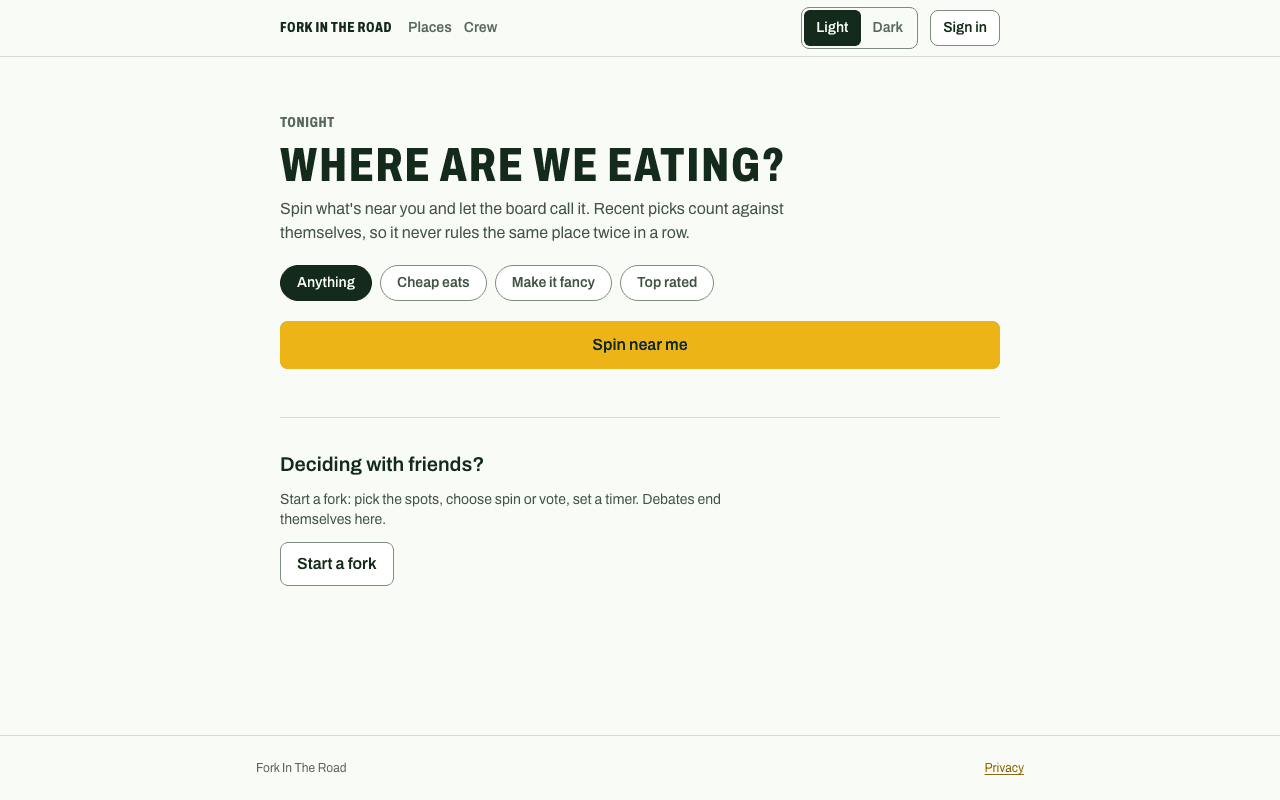
Fork In The Road ends the "where should we eat" spiral: one link, everyone votes, live results, no accounts required. Version one did all of that and had grown the way side projects grow, to roughly 113,000 lines, 77 API routes, and 27 runtime dependencies, with a notification stack across four channels and a homegrown observability platform nobody asked for. The brief for version two was a full product re-imagination: find the one sentence the product actually is, delete everything that does not serve it, and let strangers vote securely on an unauthenticated write surface.
- role
- Solo: product, design, build, ship
- timeline
- 9 phases, one PR each, July 2026
- status
- Live at forkintheroad.app
The thesis fit in one sentence
Watching how people actually used version one produced it: the product is the moment the debate ends. Everything in version two serves that sentence.
- The Fork is the atom. A decision: a source, a mode, a lifespan. Not collections, not groups, not profiles.
- The group chat is the platform. Version one required both sides of a decision to have accounts and be "friends." Version two's fork link lets anyone vote with just a display name. Accounts are for keeping things, not for participating.
- Structure emerges from behavior. Version one asked users to build groups before deciding anything. Version two watches decision history and suggests a crew after the same people finish three forks, back-attaching that history so shared weights work from day one.
- Deletion is a feature. SMS and its bill, the URL shortener, the in-app notification center, the homegrown observability platform, CSV export, onboarding tours: all dead. What remained got sharper.
The decisions
decision 01 / 05
Sign the ballot, not the guest
Guest voting is an unauthenticated write surface, which is normally a security hole with a product name. A participant is a userId XOR a guestId: guests get a signed httpOnly cookie carrying zero personal data, and claiming an account later converts the guest through a one-way pointer, so one human can never become two ballots.
The surface shipped with a security checklist in the PR: HMAC-signed fork tokens verified before any database read, layered rate limits (per-IP, per-fork, per-user), atomic in-place revotes so replays are idempotent, ballot caps enforced in the push guard, and expiry checked on every write.
Tradeoff taken: a guest who clears cookies loses their vote. Acceptable, because the alternative was an account wall, and the account wall is what kills group adoption.
decision 02 / 05
Kill the cron
Deadlines need enforcing, but cron jobs fail silently and cost money at idle. So there are none. Expiry is enforced lazily on every read, and the SSE stream that keeps the room live doubles as the timer.
Closing seals the fork with a status-guarded write first, then computes consensus from the sealed document. A closer that crashes mid-seal is finished by the next reader, and racing closers cannot produce two results.
Tradeoff taken: a fork nobody reads seals late. Nobody is waiting on a fork nobody reads.
decision 03 / 05
Port the decision math untouched, and prove it
The weighting engine was version one's proven IP: 30-day decay weights with a 10% floor, weighted spin, 3/2/1 ranked consensus. It was ported pure, with history, clock, and RNG injected, and pinned with unit tests asserting bit-identical parity with version one's curve, bucket boundaries, and tie-break behavior.
Migrated decisions keep their original timestamps, so the weight a place carried on cutover day is exactly the weight it carried the day before. Five other modules survived the purge on the same merit test: the structured logger, the DB connection singleton, the fixed-window rate limiter, the notification-suppression seam, and the API cost tracker.
Tradeoff taken: version one's curve, quirks included, is now version two's contract. I gave up the chance to redesign the math while everything around it changed, because the weights are the product's memory and memory you cannot trust is worse than none.
decision 04 / 05
Make the billing gate default-closed
Google Places is the one API that costs money per call, and version one called it from two duplicate clients. Version two can only reach it in production or with an explicit opt-in environment variable. Dev, CI, and tests run on seeded fixture data and can never bill.
The end-to-end suite proves real multi-user journeys, guest voting in incognito contexts, SSE convergence, claiming, crews, without making one real API call.
Tradeoff taken: development never exercises the live integration by accident, which also means fixture drift is a real risk I accept and check for deliberately. A test suite that can quietly bill a credit card is not a tradeoff, it is a defect.
decision 05 / 05
Migrate by reusing v1 ids, behind a human gate
The migration reuses version one's document ids in version two, which makes it idempotent and fully traceable. It has a strictly read-only dry run, and the execute path demands the target database name typed back. The owner's sign-off on the dry run gated the cutover PR itself.
Version one kept running untouched at the root while version two grew at /beta, then swapped in wholesale. Old fork links survive through permanent redirects, and returning browsers shed version one's service worker via a self-destructing replacement served at the same URL.
Tradeoff taken: version two's keyspace is coupled to version one's forever. In exchange, re-running the migration is safe by construction, and any v2 document can be traced straight back to the v1 record it came from.
The one long animation
The visual identity rations its gold to decision moments, and the split-flap reveal is the single sanctioned long animation. It never teases the winner mid-spin, collapses to a crossfade under reduced motion, and screen readers hear the outcome, not the theater.
Every palette pair was verified numerically (OKLCH to sRGB) before becoming a
token. The dark-mode axe scan still caught a white-on-gold 1.3:1 contrast bug
the numbers had not covered, which became a mode-invariant --gold-ink token
and a written rule in the identity doc.
The numbers
| Measure | v1 | v2 | Delta |
|---|---|---|---|
| Lines of code (src, e2e, scripts) | ~113,000 | ~20,000 | -82% |
| API route handlers | 77 | 20 | -74% |
| Runtime dependencies | 27 | 10 | -63% |
| Notification channels | 4 (SMS, email, push, in-app) | 2 (push, email) | |
| Sign-up fields | 4 | 2 | |
| Votes without an account | impossible | the core mechanic |
Same rigor at a fraction of the size: every phase merged with type, lint, format, Jest, and build gates green, real multi-user end-to-end journeys against a production build, axe WCAG AA scans in both color modes, and Lighthouse floors in CI.
What I would do differently
- Write the thesis sentence first. Most of the 93,000 deleted lines were the cost of building features before knowing what the product was. The one-sentence test now comes before the first commit, not after the 113th thousand line.
- Delete on the first invoice. The SMS bill had been arguing for its own deletion for months before the rewrite listened. Cost surfaces now get the merit test on a schedule, not at rewrite time.
- Scan per mode from the first token. The numeric OKLCH checks verified the pairs I expected to co-occur; the white-on-gold bug lived in a pair I had not predicted. Per-mode accessibility scans are now part of the token pipeline itself, which is a lesson this portfolio's own CI inherited.