Case study / overlapp
Building overlapp: the "when are you free?" question, answered by Postgres
overlapp replaces the one-off scheduling poll with a persistent shared calendar: each member's availability lives continuously, assembled from synced calendars and hand-entered recurring blocks, so a group sees overlapping free time without anyone asking. It went from empty repo to live product in eleven days, spec first: the data model and the privacy rule were written down before the first migration. The hard constraint was that a group calendar is a privacy problem wearing a convenience costume, so the "members learn when you are busy, never why" rule is enforced in the database, not in the UI.
- role
- Solo: product, design, build, ship
- timeline
- 11 days, spec first, June 2026
- status
- Live at overlapp-psi.vercel.app
The premise fit in one rule
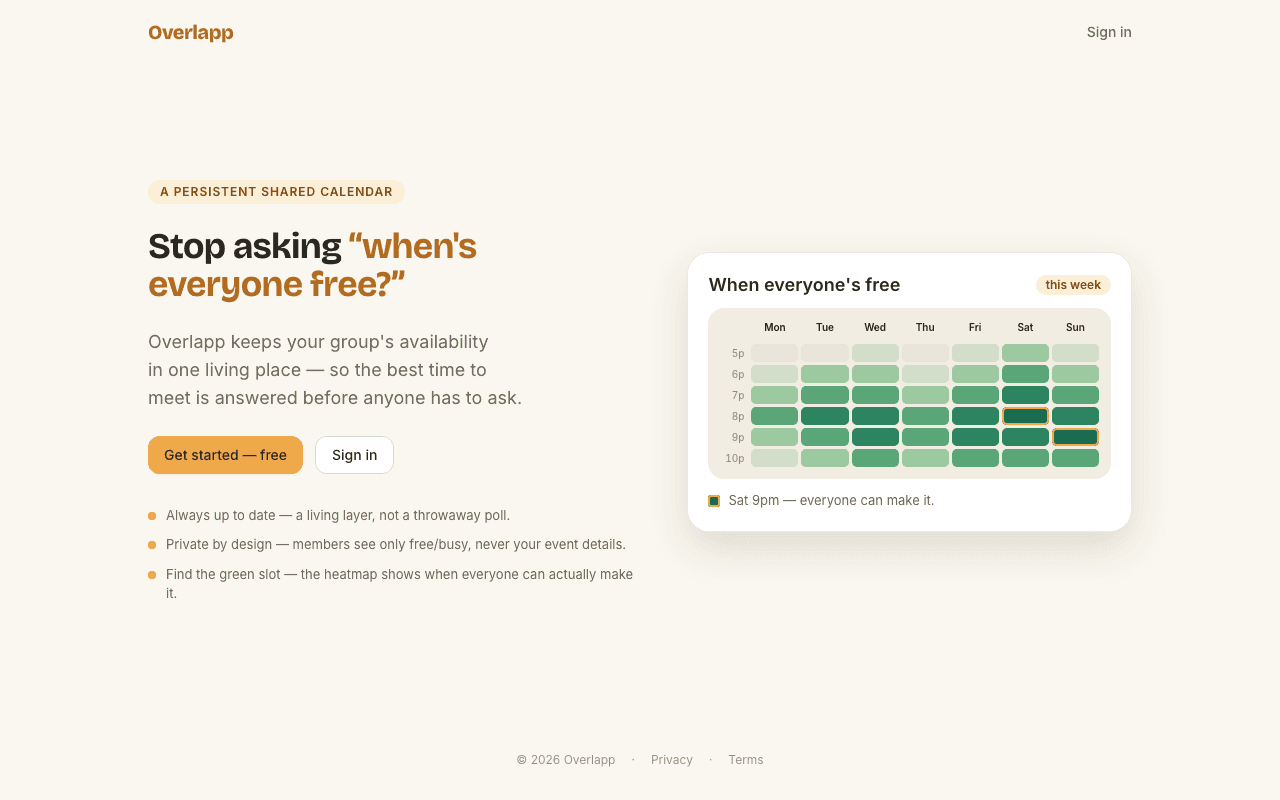
Scheduling polls die because they are snapshots. The moment a When2Meet closes, it is wrong. overlapp keeps availability alive instead: calendars sync on a rolling window, manual blocks recur, and the group heatmap is always current, so "when are you free?" stops being a question anyone has to ask.
A persistent group calendar is also a privacy problem wearing a convenience costume. The rule that shaped the whole build: members learn when you are busy, never why. Not as a UI convention, as a database guarantee.
The decisions
decision 01 / 05
One sync path, two thin adapters
Google and Microsoft calendar sync are architectural twins with different manners. All stateful logic, database writes, token persistence, idempotency, the rolling sync window, lives once in a provider-agnostic orchestrator; each provider supplies a 21-line adapter that is pure API I/O.
The seam earns its keep at token refresh: Google rarely re-issues a refresh token, Microsoft rotates it on every use. The orchestrator keeps the old token unless a new one arrives, and both providers map their invalid-grant responses to one shared reauth signal so the UI has a single "reconnect needed" state.
Tradeoff taken: the seam is validated by unit tests and one live provider, not two in production. Microsoft is code-complete behind a compile-time flag, shelved for the MVP, so I am carrying finished code that has never met a real user.
decision 02 / 05
Teach Postgres to read recurrence rules
Recurrence expansion is a hand-written plpgsql function running inside Postgres, not a JavaScript library call. It iterates with a hard 20,000-step safety cap, pins the session to UTC so weekday math is deterministic no matter who calls it, and degrades a malformed rule to a one-off event instead of silently dropping it.
Writing it once in the database paid off four times: the same expander powers personal busy intervals, the group busy view, the availability heatmap, and recurring hangouts.
Tradeoff taken: I reimplemented a deliberate subset of RFC 5545 by hand: daily, weekly, and monthly frequencies with intervals, counts, end dates, and weekly by-day. No monthly by-day, no by-set-position. Recurrence logic in SQL is also harder for the next reader than TypeScript would be.
decision 03 / 05
Strip the 'why' inside the database
Calendar events and manual blocks are owner-only under row-level security. The group-facing functions run as the definer, check membership first, and return bare busy intervals: user, start, end. No title, no category, no source. A non-member gets an empty result, never an error that would confirm the group exists.
One deliberate exception, documented in the migration itself: RSVP tallies on proposals are not anonymized, because members explicitly voted on that event, so the counts are theirs to see.
Tradeoff taken: SECURITY DEFINER functions are a sharp edge: one missing membership check in a definer function would leak every member's calendar. I accepted that edge and mitigated it with an emptied search path, explicit revoke-then-grant on every function, and grant tests that fail if permissions drift.
decision 04 / 05
Compute the heatmap on demand, and say so
The group heatmap is generated per request: a slot series joined against expanded busy intervals, with a per-slot count of who is free and an everyone-free verdict. No precomputation, no cache invalidation problem, no stale answer.
Tradeoff taken: the design explicitly bets on small groups: slot sizes of 15, 30, or 60 minutes, windows capped at 45 days, cheap for fifteen members or fewer. Past that it would need materialized aggregation, and I chose not to build for a scale the product does not have.
decision 05 / 05
Write back to real calendars through a ledger
When a proposal locks, the winning slot is written into every opted-in member's actual calendar. Each write is recorded in a ledger keyed on proposal and member, so a re-lock can never double-book, one member's expired token never blocks the rest, and unlocking deletes the remote event before clearing its ledger row, never orphaning an entry in someone's real calendar.
Tradeoff taken: pushing events into third-party calendars is best-effort by nature. Partial success is a normal outcome, reported per member, and there is no transaction across other people's Google accounts. Pretending otherwise would have meant building a distributed rollback for a hangout.
The numbers
| Measure | a fresh poll | overlapp |
|---|---|---|
| Availability data | retyped per event | synced, always current |
| What the group sees | your whole grid | busy or free, nothing else |
| Where privacy is enforced | nowhere | in the database |
| Deciding | organizer eyeballs it | proposals with quorum voting |
| The chosen slot | copy it yourself | written into real calendars |
Eleven days of work, measured: 26 ordered migrations, 35 Postgres functions of which 13 run as definer, and 160 test cases. The integration suite is the part I trust most: 2,400 lines that exercise the real row-level-security path with multiple users, instead of mocking the database and testing my own assumptions.
What I would do differently
- Ship the second provider or delete it. Microsoft sync is finished, unit-tested, and turned off. Carrying dead-but-done code is the worst of both: it cost the build time and earns no user trust. The adapter seam did its job; the flag has overstayed.
- Keep the README as honest as the code. It still says "Phase 1 in progress" while the repo has shipped proposals, dual sync, write-back, and push notifications. The audit that caught it was reading my docs, and my docs were underselling the work by three phases.
- Decide the authorization home earlier. Some checks live in row-level-security policies and again inline in the definer functions. Each duplicate is a chance for the two to disagree; the grant tests police drift, but one declared home would remove the question.