Case study / proteinchecker
Porting ProteinChecker: one line of math, kept honest across platforms
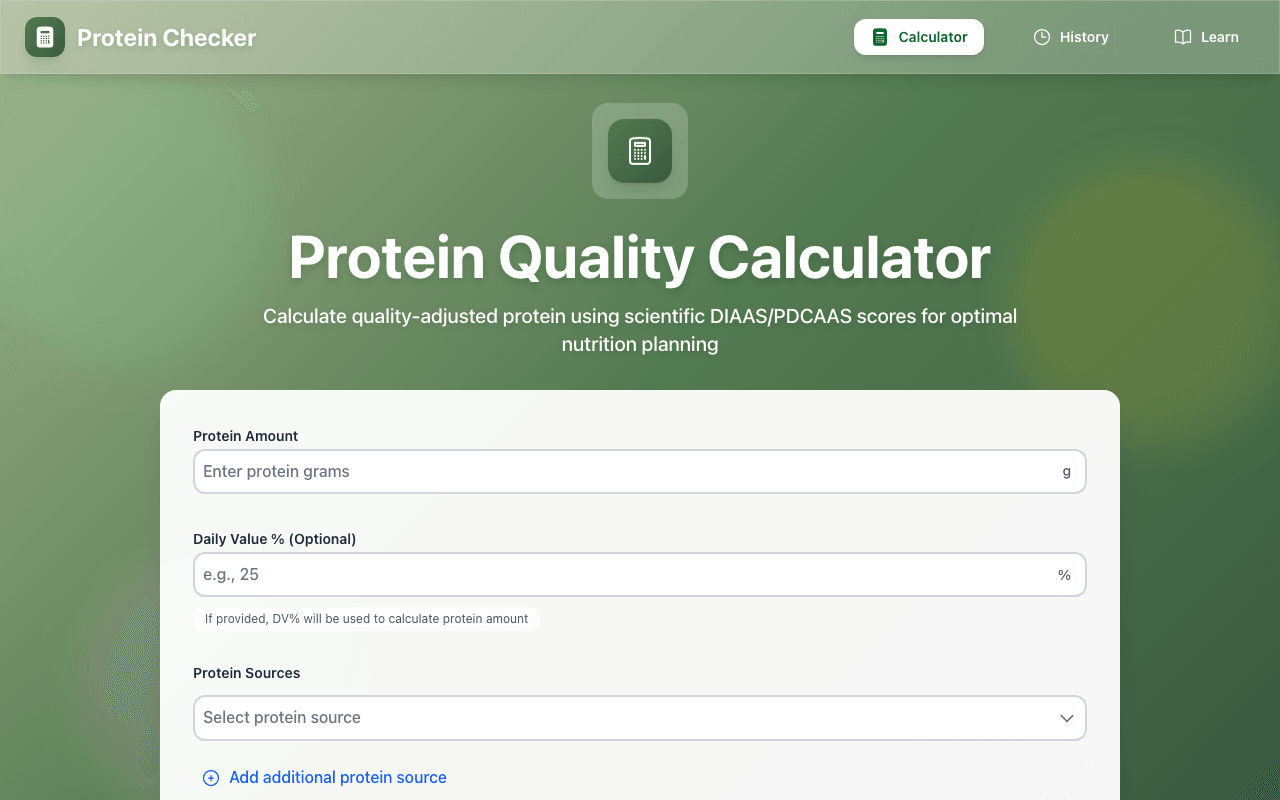
ProteinChecker multiplies the protein grams on a label by the source's digestibility score (DIAAS or PDCAAS), because 30 grams of collagen is not 30 grams of whey. The algorithm fits in a sentence; the project is really about what happens when one small product is built three times, as a React Native prototype in May, a native SwiftUI app in June, and a Next.js web port in September. The port shipped with a written parity matrix instead of a shared codebase, which worked, then quietly stopped being true the day the web version pulled ahead.
- role
- Solo: product, design, build, ship
- timeline
- May to September 2025, three builds
- status
- Web live; iOS runs from Xcode
The honest scope, up front
The core algorithm is one multiplication: stated protein times a digestibility score. There is no clever data structure here and no distributed system, and pretending otherwise would insult your time. What this project is actually about: the same small product built three times, and the discipline it takes to keep three hand-written copies of one product truthful.
The sequence: a React Native prototype in May 2025 that never left my machine, a native SwiftUI app in June that got the product right, and a Next.js port in September, built explicitly as a conversion project with its own written strategy doc.
The decisions
decision 01 / 04
Port by hand, line for line
The Swift calculation engine became TypeScript as a deliberate line-for-line translation: same function names, same fallback score for unrated sources, same edge-case handling for suspicious label-versus-calculation discrepancies, even the same traffic-light color thresholds.
For a codebase this size, hand-porting was faster than building a shared abstraction, and it kept each platform idiomatic instead of lowest-common-denominator.
Tradeoff taken: no shared module, no codegen, every constant re-declared per platform. The port stayed faithful because I compared the files function by function, and that is exactly the kind of promise that holds only as long as someone keeps making it.
decision 02 / 04
Give both platforms the same persistence contract
The iOS app persists through a UserDefaults-backed store; the web port mirrors it over localStorage with the same storage key, the same 100-item history cap, and the same method surface: save, list, delete, clear, export, import, stats. Reading the two files side by side is the fastest proof of parity in the project.
Tradeoff taken: key-value blobs instead of a real database on both sides. Fine at a 100-item cap, and honestly sized to the product: a calculator's history is a convenience, not a ledger.
decision 03 / 04
Document the parity instead of testing it
The conversion shipped with a written strategy doc: a component-by- component mapping table from SwiftUI views to React components and an algorithm table asserting the engine, validation, and formatting were converted one to one. Verification was manual: run both apps, compare outputs.
There are zero automated tests on any platform. For pure functions this small, that is not a scale problem, it is a chosen debt, and I have paid interest on it.
Tradeoff taken: a matrix is a snapshot, not a guarantee. It was accurate the week it was written and nothing enforces it since. The honest label for this approach is manual parity, and its failure mode is decision four.
decision 04 / 04
Let the web pull ahead, on purpose
The web version doubled the source database from 37 entries to 75 and added multi-source weighting: log a shake that is half whey and half soy, and the effective quality score is the weighted average. Neither made it back to iOS. Each platform hand-maintains its own database file and its own constants, so the copies drifted exactly the way hand-maintained copies do.
Tradeoff taken: '100 percent feature parity' became a one-directional claim the moment the web shipped features iOS never got. The superset was the right product call and the parity story stopped being the simple one; this study is where the record gets corrected.
The numbers
| Measure | iOS, June | web, September |
|---|---|---|
| Protein sources in the database | 37 | 75 |
| Calculation engine | 157 lines of Swift | 299 lines of TypeScript |
| History cap | 100 items | 100 items |
| Persistence | UserDefaults | localStorage, same key |
| Multi-source weighting | not built | weighted percentages |
| Automated tests | 0 | 0 |
The middle rows are the parity holding. The first and fifth rows are the parity drifting, thirteen weeks after it was documented as total.
What I would do differently
- Share golden vectors, not vibes. A single JSON fixture of inputs and expected outputs, run by a trivial test on each platform, would turn the documented parity into enforced parity for an afternoon's work. This is now my default for any hand-ported logic.
- Generate the database. The 37-versus-75 divergence happened because each platform owns its own source file. One canonical dataset emitted to Swift and TypeScript would have made drift a build error instead of a discovery.
- Declare the superset. When the web pulled ahead, the honest move was to update the parity claim the same day. Docs that flatter the project age worse than docs that describe it.